SprintWeek — Designing a platform for shared learning
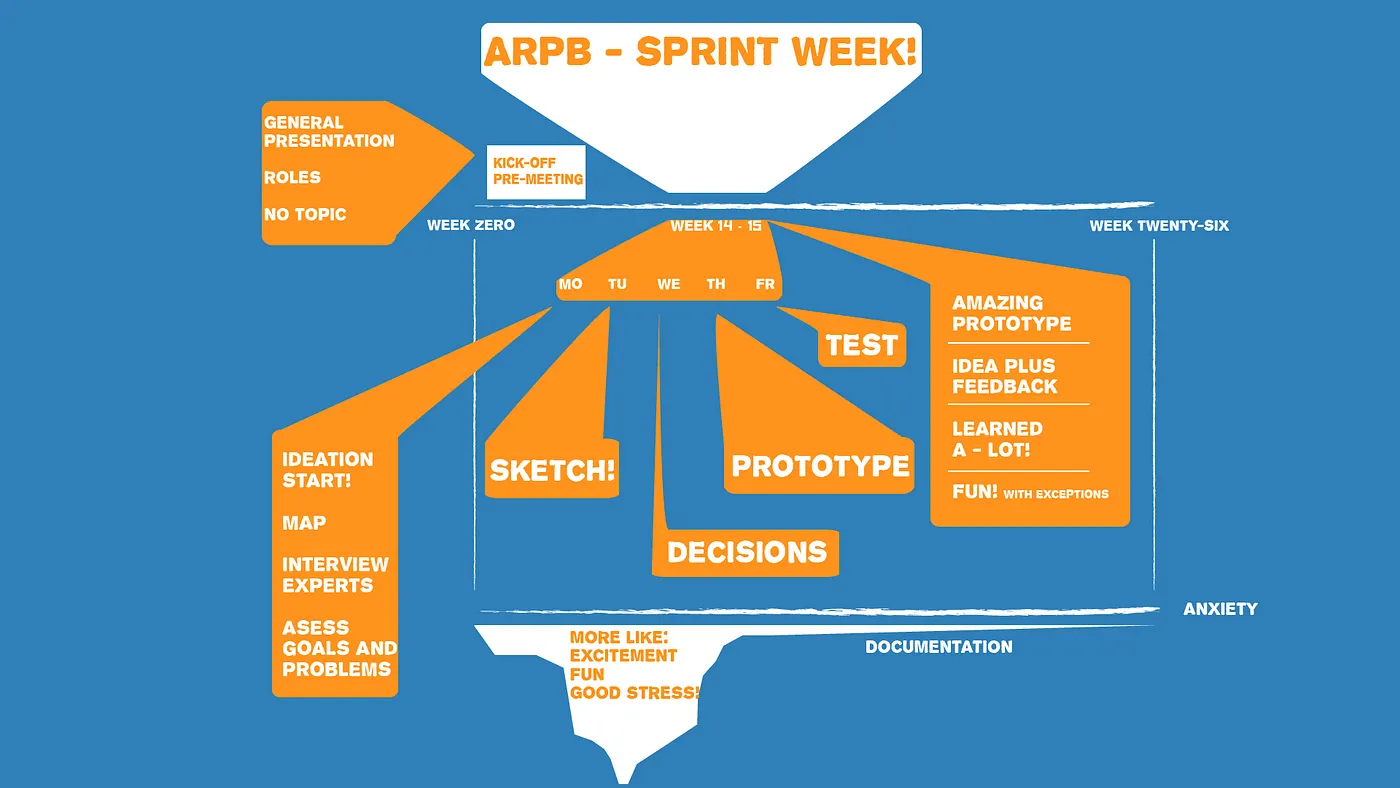
As part of a university-based design sprint at Rhine-Waal University, our 12-person team explored how a digital platform could help people create, document, share and recreate projects. Within just five days, we moved from an undefined challenge to a tested high-fidelity prototype.
Client
Hochschule Rhein-Waal
Industry
Education
Timeline
1 week
Technologies

Summary
In a five-day Google Ventures Design Sprint, our team explored a platform for creating, documenting and sharing projects. Through expert interviews, mapping, ideation, rapid prototyping and usability testing, we transformed an early concept into a tested high-fidelity prototype and identified the key principles needed to make documentation easier and project recreation more accessible. The project followed the Google Ventures Design Sprint framework and combined expert interviews, collaborative mapping, individual ideation, prototyping and usability testing. Medium article
Key data
My Role: UX/UI Designer · Sprint Team Member
Duration: 5 days
Context: University design sprint
Methods: Expert interviews · Mapping · HMW questions · Crazy 8s · Solution sketches · Storyboarding · Prototyping · Usability testing
Tools: Sketch · Photoshop · InVision
Outputs: High-fidelity prototype · Usability insights · Product direction
The challenge
People often have ideas and projects they would like to share, but documenting the process can be time-consuming and difficult to understand. Our goal was to explore how a platform could make documentation more accessible and help others reproduce successful projects.
Our process
Understand
We defined long-term goals, mapped stakeholders and workflows, and interviewed experts to challenge our initial assumptions.
Define
Using How-Might-We questions, we identified the most important opportunities and focused on three core areas: sharing ideas, documenting projects and making them easy to recreate.
Explore
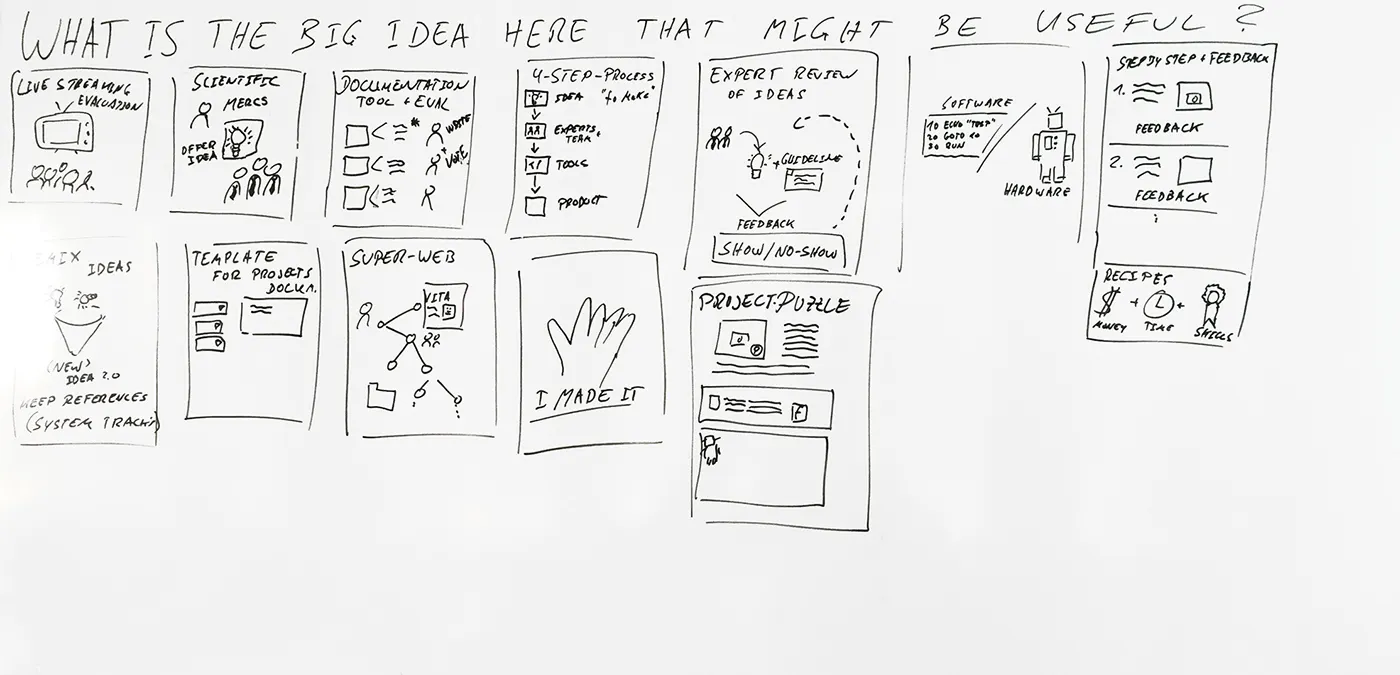
We used lightning demos, individual ideation, Crazy 8s and solution sketches to generate and compare different approaches.
Decide
Through an art museum, heat-map voting, speed critiques and super voting, we narrowed down the strongest ideas and aligned the team around a shared direction.
Prototype
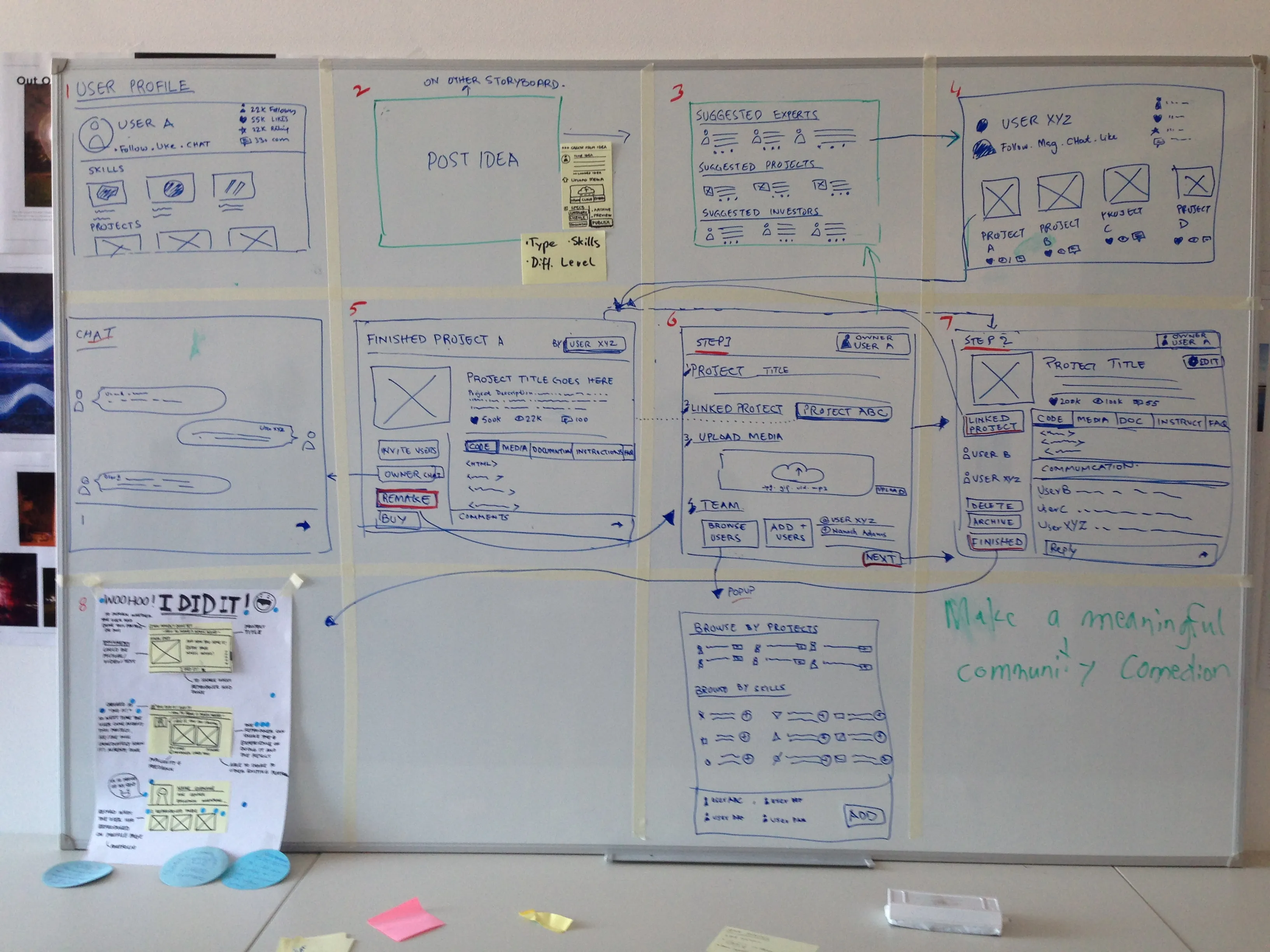
We combined the selected concepts into a storyboard and created a high-fidelity prototype using a shared UI kit and interactive prototyping tools.
Validate
On the final day, we tested the prototype with three participants, observed their behaviour and collected feedback through interviews and usability sessions.
Key learnings
The sprint showed us how important it is to involve users early, simplify complex workflows and make decisions within clear boundaries. We also learned that a good storyboard should focus on the main user goal before getting lost in interface details.
The final insights centred around three product priorities:
Remove the friction from documentation
Make project recreation simple
Create engagement through community and rewards
Outcome
The project resulted in a tested high-fidelity prototype and a clearer understanding of the product’s core value proposition. More importantly, the sprint demonstrated how a structured, human-centred process can help teams move from uncertainty to a validated product direction in a very short time.

More Project
</
>

